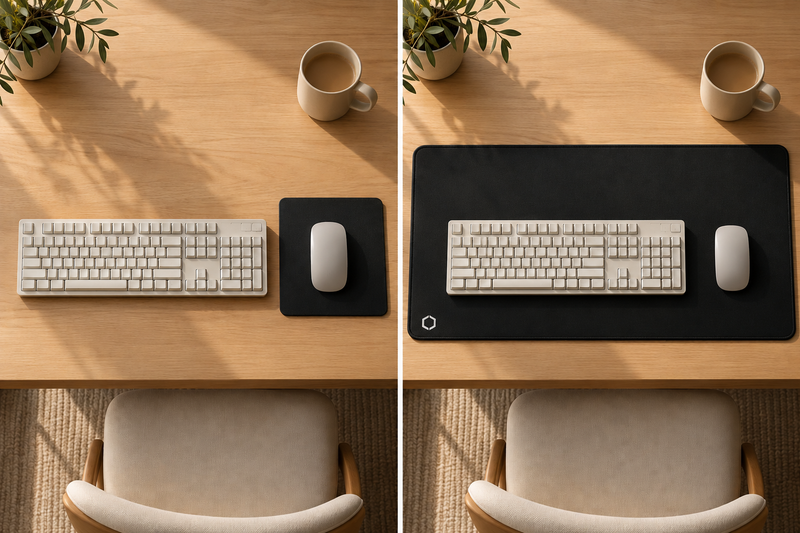
Most desk mats are made of two layers: a top surface of woven fabric, felt, leather (real or PU), cork or plastic, and a base that grips the desk, usually natural rubber, neoprene or cork. The top decides how the mat feels under your hands and your mouse. The base decides whether it stays put.
Below: what each material is, how it behaves day to day, a side-by-side table, and the questions worth asking before you choose.
Desk mat materials at a glance
| Material | Used for | Feel under the hand | Under a mouse | Spills and care |
|---|---|---|---|---|
| Woven fabric (cloth) | Top | Soft, matte, warm | Even, predictable tracking on a tight weave | Blot, then wipe with a damp cloth; air dry flat |
| Felt (wool or synthetic) | Top | Thick, soft, warm | Depends on how dense and smooth the felt is | Absorbs liquid, so blot quickly |
| Genuine leather | Top | Firm, smooth, formal | Smooth; can be less consistent for a sensor | Dry or barely damp wipe; keep away from water |
| PU (faux) leather | Top | Smooth, slightly synthetic | Smooth, similar to leather | Wipes clean; the coating can wear with time |
| Cork | Top or base | Firm, light, slightly textured | Textured; varies by finish | Resists water; wipe dry |
| Clear plastic or PVC | Top | Hard, cool, slick | Fast; can feel slippery | Wipes clean |
| Natural rubber | Base | Not touched | Not applicable | Grips the desk; resists water |
| Neoprene | Base | Not touched | Not applicable | Flexible cushion; wipe with mild soap |
What is the top of a desk mat made of?
The top is the part you see and touch, so it carries most of the choice.
Woven fabric
A fabric top is a tight woven cloth, often polyester or a microfibre blend, laid over a rubber base. A fine, even weave feels soft and matte under the wrists and gives a mouse sensor a consistent texture to read. It is a common choice for everyday work desks. What separates a good one from a poor one is the weave (tight and even) and the edge (stitched, not heat-cut).
Felt
Felt is not woven at all: it is made by matting, condensing and pressing fibres together. Premium felt mats often use wool felt; others use synthetic fibres such as acrylic, or a blend. Natural wool felt dampens vibration and absorbs sound, which can soften the sound of typing. It also holds liquid, so a spilled coffee soaks in rather than sitting on top. How a mouse feels on felt depends on the density and finish, so check what the maker says before you buy.
Leather and PU leather
Genuine leather gives a formal, blotter-style desk and ages with a patina. PU leather, sometimes called faux or vegan leather, is a fabric base with a polyurethane coating and an embossed grain. It wipes clean easily, but on some PU finishes the surface can wear off over time. Choosing between leather and fabric is a decision of its own; we compare the two in leather vs fabric desk mats.
Cork
Cork comes from the outer bark of the cork oak. The tree is not cut down: the bark is stripped, then grows back, and is harvested again roughly every nine years. Cork is light, elastic and close to watertight. On desk mats you will find it as a full top, or as a thin base layer under felt or leather.
Clear plastic and PVC
A clear plastic sheet protects a desk while leaving the wood or finish visible. It is hard, smooth and easy to wipe, but it offers little comfort for resting wrists and can feel slippery under a mouse.
What is the base of a desk mat made of?
The base does the quiet work: it keeps the mat in place while you type and move the mouse.
- Natural rubber is made from latex tapped from the rubber tree. It is elastic, springs back and resists water, which is why a full natural rubber underside grips a desk well.
- Neoprene is a synthetic rubber (polychloroprene). It stays flexible across a wide range of temperatures and is used as a cushioned base on some mats.
- Cork is used as a light, non-slip backing, especially under felt and leather tops.
Look at how much of the base actually grips. A full rubber underside holds better than a few strips or dots, and it lies flatter.
Which desk mat material is best?
There is no single best material. There is a best material for how you work:
- You use a mouse all day: a fine weave fabric top. It gives the most predictable tracking for everyday work.
- You want a quieter, softer desk: wool felt or a fabric top over a rubber base. Both soften the tap of keys on a hard desk.
- You write by hand more than you type: leather or a firm cork top, in the blotter tradition.
- You want to show off the desk itself: clear plastic.
- Spills are common at your desk: PU leather, cork and plastic are the easiest to wipe dry. Fabric works if you blot right away. Felt is the least forgiving.
What matters more than the material?
Two mats in the same material can be very different. Three details decide how long a desk mat lasts:
- The edges. Stitched edges hold the rectangle and stop fraying. Heat-cut or glued edges tend to lift and fray first.
- The base coverage. A full base grips evenly; partial backing lets corners lift and slide.
- The thickness. Thin enough to slide under a monitor stand, thick enough to soften the desk. Measure the gap under your stand before you choose.
We go deeper on construction in what makes a desk mat premium.
What is the Difavo Desk Mat made of?
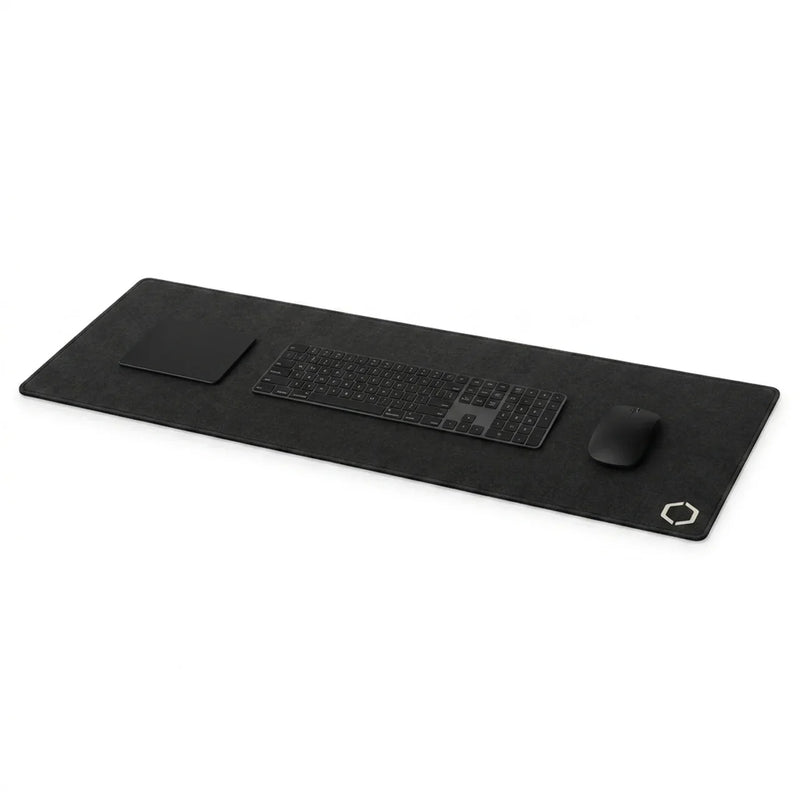
We chose fabric over felt and leather for an everyday work desk. The Difavo Desk Mat pairs a fine weave fabric top, smooth and precise under a mouse, with a full natural rubber base that stays where you set it, and precision-stitched edges on all four sides. It measures 900 × 400 mm (35.4 × 15.7 in) and 3 mm thin, in matte black. $49 CAD, designed in Canada, with free shipping across Canada.
Frequently asked questions
What are most desk mats made of?
Most desk mats have a woven fabric, felt, leather, PU leather or cork top over a natural rubber, neoprene or cork base. Fabric over rubber is a common pairing for everyday work desks.
Is felt or leather better for a desk mat?
Felt is softer, warmer and quieter, but it absorbs spills. Leather is smoother and wipes clean, but it needs more care and can feel slick under a mouse. Choose felt for comfort and sound, leather for a formal writing surface.
Is a cork desk mat a good idea?
Yes, if you like a firm, natural surface. Cork is light, elastic and close to watertight, and it is harvested without cutting down the tree. It is less soft under the wrists than fabric or felt.
How do you clean a neoprene desk mat?
The neoprene is usually the base; you clean the top. Wipe the surface with a damp cloth and a drop of mild soap, then let the mat air dry flat. Our guide on keeping a desk mat flat and clean covers stains and curling.
What desk mat material is best for a mouse?
A tight, even woven fabric gives most mouse sensors the most consistent surface. Smooth leather and glossy plastic can feel less predictable.
Sources for material facts: Wikipedia, Felt, Cork (material), Natural rubber, Neoprene and Artificial leather, consulted October 2026.
Written by the Difavo design studio in Ontario, Canada.